 Sri lanka Muslims Web Portal Sri Lanka Muslims News Center
Türkiye, Syria and Jordan have pledged to restore and modernise the line, a project officials and experts say could carry not only trains, but also the promise of economic revival and regional reconciliation.
At a tripartite technical meeting of the transport ministries in Amman on September 11, the three countries agreed to take “the first concrete step” toward reviving the line.
The track connects Türkiye, Syria, Jordan and Saudi Arabia, traversing 1,750 kilometres and connecting some of the most important urban centres in the region.
Türkiye’s Minister of Transport and Infrastructure, Abdulkadir Uraloglu, said that Ankara will support Syria in completing 30 kilometres of missing track infrastructure, while Jordan will explore technical capacity for locomotive maintenance and the potential to operate its historic engines as far as Damascus.
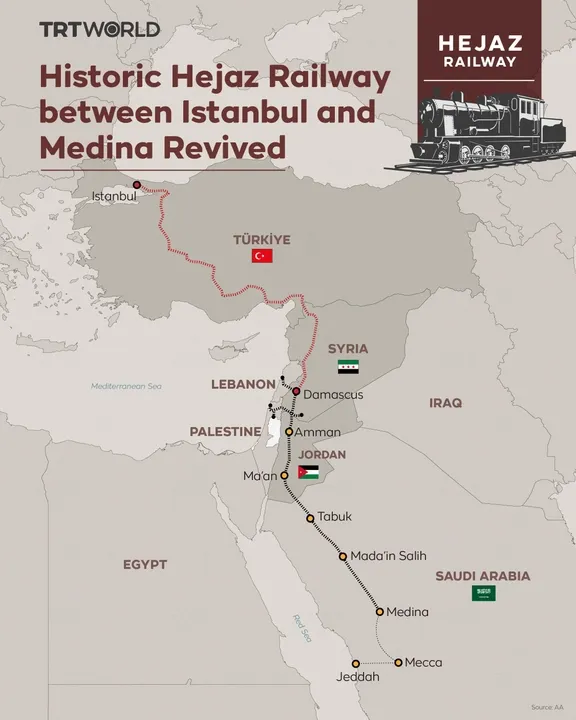
Hejaz Railway – TRTWORLD
Associate professor Suay Nilhan Acikalin, an international relations academic at Haci Bayram Veli University in Ankara, says that the re-opening of the Hejaz Railway would not be just “a powerful historical symbol but also a tangible driver of prosperity and regional cooperation”.
“The revival of the Hejaz Railway is of great significance for the region,” she tells TRT World.
The Amman talks also produced a draft memorandum of understanding to deepen transport cooperation across road, rail and logistics corridors.
The document is expected to be signed later this year at the ministerial level. Türkiye will prepare a detailed action plan ahead of the meeting, setting out concrete steps for trilateral technical groups to pursue.
One of the most immediate outcomes was an agreement to resume road transport between Türkiye and Jordan via Syria, ending a 13-year suspension.
Minister Uraloglu also pointed to the strategic importance of connecting Türkiye more directly with the Red Sea through Jordan’s Aqaba Port, a move that could strengthen supply chains across the Middle East and beyond.
Strategic significance of Ottoman-era Hejaz Railway
Acikalin places the revival of the railroad within a larger geopolitical context, underscoring both the symbolism and the practical value of the initiative.
“It is one of the projects that has taken concrete form within Türkiye’s broader efforts over the past three years—both in the fight against terrorism and in advancing development goals.”
“Alongside the Development Road Project with Iraq and a potential northern corridor through Zangezur, this initiative represents a multidimensional push toward growth,” she adds.
Acikalin emphasises that renewed stability in Syria – following the fall of the Asad regime – has made such projects possible.
“For decades, the areas traversed by the Hejaz Railway were crippled by conflict,” she notes.
“Yet with Syria now entering a period of stabilisation, the prospect of reviving this line—linking Iraq, Syria, Türkiye, and the broader region—has become both feasible and deeply significant.”
International relations scholar, Professor Oktay Firat Tanrisever from the Middle East Technical University in Ankara, stresses the project’s strategic and economic dimensions.
“Restoring and modernising the historic line—particularly the Syria–Jordan connection—would reopen a vital trade corridor between Türkiye and the Red Sea,” he tells TRT World.
“Türkiye could greatly expand its trade with Saudi Arabia and the Horn of Africa, delivering goods more quickly, reliably, and cost-effectively,” he continues.
“For Syria, this would create new trade routes and boost overall commerce among regional states. Cooperation in transportation between Türkiye, Syria, and Jordan will not only extend access to wider geographies but also foster stability and development across the region.”

A railway with a past and a future
Originally inaugurated in 1908, the Hejaz Railway was built to connect Istanbul with Medina, facilitating both trade and pilgrimage. In its earliest days, the railway carried pilgrims on their sacred journey to the holy cities, stitching together distant communities across deserts and frontiers.
The railway was built between 1900 and 1908 under the Ottoman Sultan Abdulhamid II, forging a vital link from Istanbul to the holy cities of Mecca and Medina, while also extending through Damascus and into parts of Yemen.
Its collapse during World War I left large stretches derelict, with surviving stations and locomotives preserved more as relics than infrastructure.
Now, with momentum from both governments and regional experts, the line is being reimagined as a project that bridges the past and the future.
“Reviving the Hejaz Railway is not only about restoring a line of steel and stone,” Minister Uraloglu stated. “It is about reconnecting peoples, opening new trade routes, and building a future of stability and prosperity in our region.”
Once realised, the line would stand as both a resurrection of history and a reimagining of the region’s future: a network of rails stretching from the Istanbul Strait to the Red Sea, carrying commerce, cooperation, peace and prosperity.
Post Disclaimer | Support Us
Support Us
The sailanmuslim.com web site entirely supported by individual donors and well wishers. If you regularly visit this site and wish to show your appreciation, or if you wish to see further development of sailanmuslim.com, please donate us
 Donate
IMPORTANT : All content hosted on sailanmuslim.com is solely for non-commercial purposes and with the permission of original copyright holders. Any other use of the hosted content, such as for financial gain, requires express approval from the copyright owners.