 Sri lanka Muslims Web Portal Sri Lanka Muslims News Center
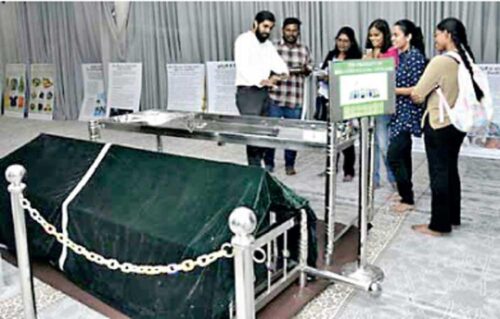
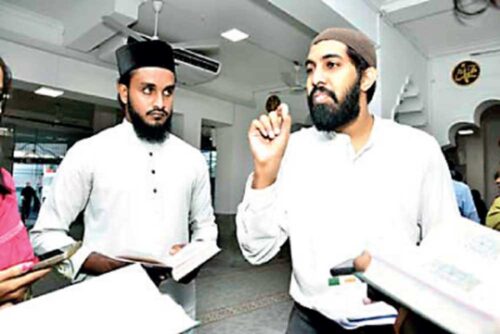
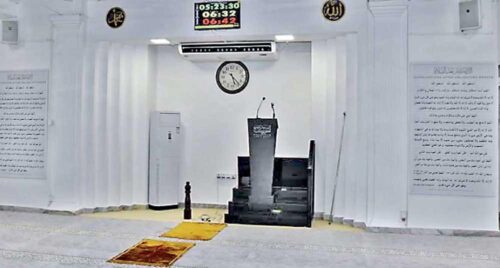
In a world clouded by misunderstanding, the Jumma Mosque at Kollupitiya (Colpetty) opened its doors to foster clarity, promote connection and provide a deeper understanding of the true essence of Islam. The recent tour of the mosque served as a valuable opportunity to explore Islamic architecture, cultural heritage and the spiritual significance of the sacred space.
The programme, conducted under the theme ‘Welcome to our Mosque’ was organised by the Centre for Islamic Studies, Harmony Centre, in collaboration with the Muslim Women’s Research and Action Forum, and was supported by Diakonia.
The following are excerpts of answers provided to some regular questions asked by individuals, including this writer, who joined the guided tour to the mosque.
One question was — what does the symbol of the crescent or the stars in the mosque symbolise.
“They have nothing to do with Islam. It is a part of an architectural culture borrowed from the Roman Empire. The devotees of Islam adopted their culture. We still present it as a memory. It has become a part of our culture now,” said Shefan Yang, who played the role of tour guide during the mosque tour.
Yang explained that followers of Islam are required to purify themselves prior to entering the mosque. This purification process was demonstrated during the tour. It was said that it is a compulsory ritual before engaging in prayer, known as embellishment, which involves washing the face, mouth, hands, arms and feet.
“The water helps the Islamic devotees to reduce their tension and helps their soul and heart to calm down before getting ready to pray,” explained Yang.
The mosque features a 210ml water tub made for this purpose. Following the pandemic, taps were installed, and the writer observed devotees using them for purification.
Delving into the religion and the facts, the discussion extended to the common Islamic names that are used. Yang spoke about a few names relating to the meaning. Mohamed – someone who praises God. Fathima – daughter of Mohamed and leader of Heaven.
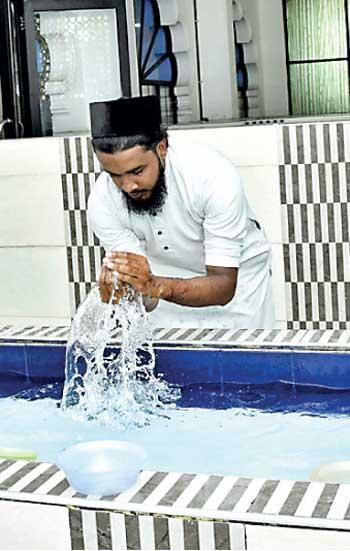 |
| Demonstrating the cleaning process before entering the mosque |
According to him, the individual responsible for delivering sermons and guiding the congregation in prayer is referred to as an Imam. Yang said that the Kaaba holds great significance during prayers in Islam. It is located at the heart of Masjid al-Haram in Mecca, Saudi Arabia. Muslims often use digital applications to accurately determine the Qibla direction and the precise degree toward the Kaaba from their current location. He added that followers of Islam pray five times a day.
“Men and women usually pray in separate spaces—not because one is lesser than the other, but to help both fully concentrate on their spiritual connection with God,” explained Yang. It was shown that during the prayer session, men turn their heads to the right and left at specific points. This movement could cause distraction if a woman were praying directly beside them, which is why the separation is maintained—to preserve focus and respect during worship.
Yang also addressed and refuted the widespread misconception that Islamic girls are prohibited from seeing their grooms before marriage. He explained that “It belongs to the Indian Tradition. The cultural aspects of Islam differ country-wise.” He further noted that certain Islamic cultures have changed as in for marriages do not practice the exchange of rings, which Sri Lankan Muslims often do.
Another question asked was whether a girl must change her religion to marry a Muslim.
“Simply, yes. The Quran specifies so unless the girl is from the Christian or Jewish faith, as we share the same testament. Jews use the Old Testament and Christians use the New Testament,” he answered. According to Yang, there would not be significant issues regarding religious beliefs within such families. Understanding about their lifestyles are unchallenging. Therefore, he said that it will be hard for the other religions to embrace Islam during family time.
He further explained: “Men can marry up to 4 women, yet all the marriages should be legalised. In order to execute this, a man should have his first wife’s approval. But this is not executed in Sri Lanka due to cultural evolution,” said Yang.
He added that the distribution of wealth is also governed by the teachings in the Quran, which provides detailed guidance on how inheritance should be divided among children.
“The Quran provides solutions to the problems of life,” he said. The Quran carries two major themes: love and forgiveness.
“Haram’ is illegal and ‘Halal’ is legal. Quran says that Islam is the last religion,” he added. He acknowledged that followers of Islam adhere to various interpretations.
According to him, during the ninth month of the Islamic lunar calendar, a Muslim devotee observes a 29- or 30-day fast, abstaining from food, drink, smoking and sexual relations during daylight hours. This ritual emphasises the development of patience, self-control, and spiritual reflection.
Another question asked was what type of duties must be executed when a Muslim dies.
According to Yang, four primary rites must be observed: the body has to be washed thoroughly, next the body should be covered entirely, then a prayer must be performed for the deceased, and finally, the body should be buried.
He elaborated that, traditionally, it is the family members who are responsible for washing the remains of the deceased. (If it’s the mother, the son or the daughter can execute the process). However, in contemporary practice, a designated individual is often hired to perform the ritual in return for payment. “We always believe that we are created from dust, so we should go back to dust, which is burying the body,” explained Yang.
In addition to the informative sessions, the event featured a henna corner, which allowed visitors to experience a traditional element of Islamic and South Asian culture. The mosque served not only as a platform to dispel common misconceptions about Islam, but also as an opportunity to promote interfaith understanding and cultural awareness.
Post Disclaimer | Support Us
Support Us
The sailanmuslim.com web site entirely supported by individual donors and well wishers. If you regularly visit this site and wish to show your appreciation, or if you wish to see further development of sailanmuslim.com, please donate us
 Donate
IMPORTANT : All content hosted on sailanmuslim.com is solely for non-commercial purposes and with the permission of original copyright holders. Any other use of the hosted content, such as for financial gain, requires express approval from the copyright owners.