 Sri lanka Muslims Web Portal Sri Lanka Muslims News Center
There’s a lot to say about the way Muslim societies dealt with poverty in earlier centuries. Charity was obviously important. But it wasn’t always as simple as handing someone a few coins and moving on.
In many parts of the Islamic world, helping people in need became connected to the way communities themselves were organised. Land was donated. Shops and houses were turned into sources of regular income. Hospitals were established. Food was prepared for people who had nowhere else to turn. Some of these arrangements lasted for generations. That’s probably one of the most interesting parts of the story.
It Started with Giving, But Went Further
 ZakatA tax that is the duty and social obligation of every Muslim. This as the fourth Pillar of Islam. More is perhaps the best-known example. As one of the Five Pillars of Islam, it created a clear obligation for eligible Muslims to give a portion of qualifying wealth to recognised categories of beneficiaries. But Muslim charity was never limited to zakatA tax that is the duty and social obligation of every Muslim. This as the fourth Pillar of Islam. More. There was sadaqah too, which could be given whenever someone wanted to help. A meal for a neighbour. Water for travellers. Money for a family going through a difficult period. Support for someone who could not afford treatment. The forms changed. The basic idea didn’t.
There was also sadaqah jariyah, where the benefit of a charitable act could continue long after the original donation. That idea becomes especially important when looking at the development of waqf.
Waqf Made Charity Last
Waqf is one of those institutions that can be easy to overlook when discussing Islamic history. It shouldn’t be. A person could dedicate property or land for a particular charitable purpose. The property itself would generally remain dedicated, while its income could be used to support a mosque, school, hospital or other service.
Think about what that means in practical terms. A shop could produce rent every year. That rent could help pay for a teacher. Or support a kitchen. Or maintain a public building. The donor wasn’t simply giving money once. A useful asset was being put into a system that could keep producing a benefit.
UNESCO’s records on historic waqf institutions show how widely this model developed across Muslim societies. One particularly striking example is the Rab‘ i-Rashidi complex near Tabriz, dating from the 13th century. It included a hospital, library, educational facilities, an orphanage and a caravanserai, among other buildings. There was a whole network behind it. The endowment deed also recorded properties and arrangements intended to keep the institution functioning. So this wasn’t just charity in the informal sense. There was administration, property management and planning involved.
What Happened When Someone Got Sick?
Healthcare is another part of the story. Bimaristans, the hospitals found in various parts of the medieval Muslim world, were used for medical treatment and, in some cases, teaching. That mattered enormously.
For a poor household, an illness could mean more than a medical problem. There could be lost income, unpaid bills and children going without basic things. Access to medical care could therefore protect a family from falling even deeper into hardship.
Education had a similar effect. Mosques and madrasas were important places of learning, and charitable endowments could help provide resources for students and teachers. In some settings, accommodation and stipends were also supported. For someone from a poor background, education could be the difference between remaining trapped in poverty and having a realistic opportunity to build a different life.
Sometimes the Help Was Simply Food
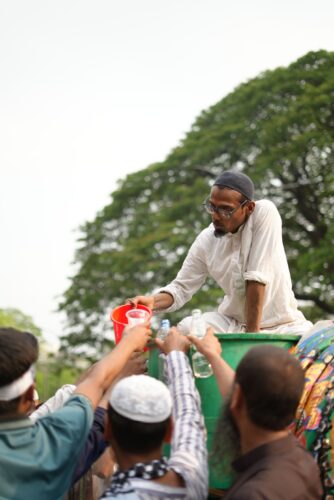
Food charity is one of the most practical kinds of help someone could give. If a person is hungry, a meal helps. Public kitchens became part of charitable life in several Muslim societies. During the Ottoman period, imarets associated with religious and civic complexes provided meals to people such as the poor, travellers and students. Bursa is one example of the wider Ottoman approach. Religious complexes could include mosques, schools, baths and food facilities, with waqf income helping to keep them running.
It’s worth remembering that food sharing also appeared around religious occasions. This included qurbani, through which meat could be shared with relatives, neighbours and people experiencing hardship. The practice sits naturally within the wider history of Muslim charitable life.
Charity Wasn’t Supposed to Humiliate People
This part of the history is easy to miss. Receiving help can be uncomfortable. Someone may be struggling badly but still not want their neighbours to know. There can be embarrassment, pride and a feeling of having lost independence.
Historical examples from Muslim societies show attempts to deal with this problem. In parts of the Ottoman world, charitable donations could be made anonymously. There were also traditions of quietly paying the debts of people who were struggling, rather than turning the assistance into a public announcement.
The details varied. The underlying concern was fairly simple: help someone without making them feel smaller. That idea still makes sense. A welfare system can provide money or food, but the way that assistance is delivered matters too. There’s a big difference between being helped privately and having to stand in front of a crowd and explain why help is needed.
It Wasn’t One Perfect System
Islamic civilisation covered enormous geographical areas and many centuries. Conditions in Baghdad weren’t the same as those in Cairo, Delhi or Istanbul. Institutions changed. Some worked well, some less so. Access to services could also depend on local circumstances.
So there was never one single Islamic welfare model. What existed instead were lots of different arrangements built around recurring principles.
- ZakatA tax that is the duty and social obligation of every Muslim. This as the fourth Pillar of Islam. More.
- Sadaqah.
- Waqf.
- Community support.
- Food distribution.
- Healthcare.
- Education.
- Water.
Sometimes these things were organised by governments. Sometimes wealthy families or merchants supported them. Religious institutions and local communities also played important roles in these initiatives. And quite often, several of these systems worked together.
The Bigger Idea Behind It
Looking back at these institutions, the interesting point isn’t simply that people in Muslim societies gave charity. Most societies have traditions of charity. The more significant point is what happened when charitable values were turned into something that could keep working.
A donated property could generate income for years. A school could educate children who had no means to pay. A hospital could treat people who could not afford private care. A kitchen could provide meals day after day. A water well could serve travellers long after the person who funded it had died. That’s a different scale of thinking. It moves charity away from the idea of a single generous moment and towards something more permanent.
Why This Still Deserves Attention
Modern poverty is obviously different from poverty several hundred years ago. Today’s cities, economies and public services are much more complicated. The old institutions cannot simply be copied. But some of the thinking behind them remains relevant.
Long-term support matters. Dignity matters. Access to healthcare and education matters. So does making sure that charitable resources actually reach people who need them. The history of waqf and other charitable institutions shows that caring for vulnerable people wasn’t always treated as an occasional religious activity. In many Muslim communities, it became part of everyday social life. That’s perhaps the most useful thing to take from the history.
A donation can solve a problem today. A lasting institution can keep solving problems tomorrow and perhaps for many years after that.
Post Disclaimer | Support Us
Support Us
The sailanmuslim.com web site entirely supported by individual donors and well wishers. If you regularly visit this site and wish to show your appreciation, or if you wish to see further development of sailanmuslim.com, please donate us
 Donate
IMPORTANT : All content hosted on sailanmuslim.com is solely for non-commercial purposes and with the permission of original copyright holders. Any other use of the hosted content, such as for financial gain, requires express approval from the copyright owners.