 Sri lanka Muslims Web Portal Sri Lanka Muslims News Center
I started my medical career in 1991 as an intern house officer to Professor A.H. Sheriffdeen, whom we affectionately called AHS.
One Tuesday morning in the surgical clinic, medical students presented the history of a homeless man with an infected wound on his foot. They explained that he had first gone to a nearby, newly built hospital but had been turned away by security personnel, who reportedly told him that only “respectable” people were admitted. As the story unfolded, Professor A.H. Sheriffdeen’s face turned red. He listened in complete silence—something highly unusual of him.
When the presentation ended, he gently examined the man, who was dressed in rags and smelt of sweat. Then he held the patient’s hand, walked over to me, and quietly said, “Can you take this man to the admitting officer, get the BHT (Bed-Head Ticket) written, and accompany him to our ward in a wheelchair?”
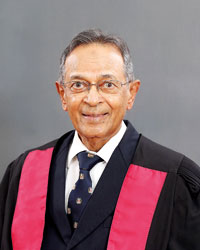
Professor A.H. Sheriffdeen
To many, this man was an unwanted burden. To AHS, he was simply another human being in pain who deserved dignity and care.
He never condemned the hospital that had rejected the patient. He did not need to. Every medical student and every doctor in that clinic learned an unforgettable lesson in compassion, equity, and human dignity. That was AHS’s style of teaching—he educated us not through lectures but through his actions. Over the following weeks, he personally supervised the patient’s treatment until the wound healed, after which the man returned to the community.
Those were the days when urinary catheters, intravenous cannulae, and even certain antibiotics were considered luxuries in government hospitals. Patients frequently had to purchase these essential items themselves. AHS had a quiet arrangement with a nearby private pharmacy: whenever a patient could not afford an essential item, one of his junior doctors would request it from the pharmacy. The supplies would arrive promptly in the ward. At the end of each month, AHS settled the bill out of his own pocket. His only request was that none of us ever reveal who had paid for them. Acts of generosity performed in silence reveal far more about a person’s character than those performed in public.
AHS insisted that every patient in his ward should be comfortable and pain-free as much as possible. He regarded uncontrolled pain as unacceptable, irrespective of the diagnosis. This posed a considerable challenge for us as house officers, since some patients with advanced peripheral vascular disease experienced excruciating pain that persisted despite repeated injections of morphine, the strongest analgesic available to us at the time.
I still remember one such patient under the care of my co-house officer, Dr (now Professor) Deepaka Weerasekera. The patient remained in agony despite every available treatment. AHS expected every patient to greet him with a smile during the ward round, and there was no excuse if they did not. Faced with an impossible situation, Deepaka resorted to an unusual solution: just before the ward round, he quietly handed the patient a fifty-rupee note and pleaded, “Whatever happens, please smile when ‘Loku Mahatthaya’ comes.” Looking back today, we laugh at the incident. Yet beneath the humour lay AHS’s unwavering conviction that relieving suffering was the surgeon’s foremost duty.
Thirty years ago, during our internship, there were very few doctors in a surgical unit. Apart from the consultant, the only resident doctors were the two house officers. Consequently, even seemingly minor problems required us to telephone the professor directly. Throughout our six months under his supervision, AHS came to the hospital countless times in the middle of the night without the slightest hesitation. He never sounded irritated or impatient—instead, he arrived cheerful, calm, and ready to help us solve the problem. What impressed us even more was that, despite these nocturnal visits, he would invariably be back in the ward or operating theatre before 8:00 a.m. the following morning, punctual and full of energy. As intern house officers, we never hesitated to telephone him at any hour because we knew we would always receive encouragement rather than criticism. His dedication to patient care and to the education of young doctors was truly legendary.
Behind these small, human moments lay an extraordinary career. Abdul Haleem Sheriffdeen received his primary education at St Anthony’s College, Katugastota, before entering the Faculty of Medicine, University of Colombo, in 1958. He joined the Department of Surgery as a lecturer in 1968 and later travelled to London for postgraduate training under the renowned Professor Harold Ellis at Westminster and Gordon Hospitals. He received specialist vascular surgical training under Felix Eastcott at St Mary’s Hospital, the pioneer who first reported carotid endarterectomy for the prevention of stroke. While in the United Kingdom, AHS obtained the fellowships of the Royal Colleges of Surgeons of England and Edinburgh. He returned to Sri Lanka as senior lecturer in surgery in 1972 and was appointed professor of surgery in 1989, a position he held until his retirement in 2003.
His contributions transformed surgical practice in Sri Lanka. Under his leadership, the Department of Surgery established one of the country’s earliest vascular surgery services and developed a vascular laboratory with duplex ultrasonography. In 1985, he led the surgical team that performed Sri Lanka’s first successful kidney transplant, working closely with Professor Geri Jayasekara. He also established the first mammography unit in the government health sector at the National Hospital of Sri Lanka in 1997.
His adherence to ethical medical practice was equally exemplary. At a time when surgeons were reluctant to operate on patients infected with HIV, AHS was brave enough not only to operate and help such patients but also to face unfair media criticism for doing so, and he did so with equanimity.
Drawing upon his vascular expertise, he pioneered many complex surgical procedures, including abdominal aortic aneurysm repair, aorto-femoral bypass surgery, Whipple’s pancreaticoduodenectomy, hepatic resections, splenorenal and hepatorenal shunts for portal hypertension, and surgery for severe, refractory lymphoedema. During the years of the North-East conflict, vascular trauma increased dramatically. AHS carried an enormous clinical burden, often operating throughout the night under extremely difficult circumstances and with limited resources. Yet his commitment to his patients never faltered.
Professor A.H. Sheriffdeen served as president of the College of Surgeons of Sri Lanka in 2000 and later as president of the Sri Lanka Medical Association during the period following the devastating 2004 Indian Ocean tsunami. Under his leadership, the association coordinated numerous initiatives to restore healthcare services, support affected healthcare workers, and rebuild damaged health infrastructure. His leadership during one of the country’s darkest periods reflected the same quiet determination and sense of responsibility that characterised every aspect of his professional life.
He not only cared for his patients during their illnesses but was also keen on bringing them back to normalcy thereafter. Many patients with trauma and vascular diseases end up as amputees, and he was hugely instrumental in starting and sustaining the Jaipur Foot programme to help the disabled. As a founder member of the Jaipur Foot Programme in 1983 and as the driving force behind the ‘Aidex’ sports festival for the disabled, he did a yeoman service to these helpless souls.
One final memory has remained with me for decades. As a postgraduate trainee attending the annual scientific sessions of the College of Surgeons, I was standing in a long queue waiting for lunch. When AHS arrived, many junior doctors immediately invited him to move to the front. Smiling, he politely declined. “I am afraid of jumping queues,” he said. “If I start jumping queues now, someone might ask me to jump the queue for death as well.” It was vintage Professor A.H. Sheriffdeen—humble, witty, and profoundly principled. Perhaps that is indeed the secret of his remarkable longevity, as he approaches 90 years soon!
As I conclude this tribute, my wish is not merely that we remember AHS with affection. The greatest tribute we can pay him is to emulate the values he embodied: compassion before prestige, service before recognition, humility before authority, and unwavering commitment to every patient irrespective of wealth, status, or circumstance. Long life is measured not only in years but also in the countless lives touched with kindness. By that measure, Professor Abdul Haleem Sheriffdeen has achieved a form of immortality that few are privileged to attain.
Anuruddha Abeygunasekera
Post Disclaimer | Support Us
Support Us
The sailanmuslim.com web site entirely supported by individual donors and well wishers. If you regularly visit this site and wish to show your appreciation, or if you wish to see further development of sailanmuslim.com, please donate us
 Donate
IMPORTANT : All content hosted on sailanmuslim.com is solely for non-commercial purposes and with the permission of original copyright holders. Any other use of the hosted content, such as for financial gain, requires express approval from the copyright owners.